









18 May - Assault (on the greenbelt) and battery
A company called Net Zero Thirty Two is planning to build on the green belt
behind North Cray Road. “High quality agricultural land” according to local
Councillors. The company’s name alone should ring alarm bells.
 Their plan (25/00833/FULM) is to install an
electrical storage battery but useful information on the
environmental impact is scarce. Net Zero 32 has provided many documents as you
might expect but whether they are wholly truthful may be debatable. The land is
described as having negligible botanical value.
Their plan (25/00833/FULM) is to install an
electrical storage battery but useful information on the
environmental impact is scarce. Net Zero 32 has provided many documents as you
might expect but whether they are wholly truthful may be debatable. The land is
described as having negligible botanical value.
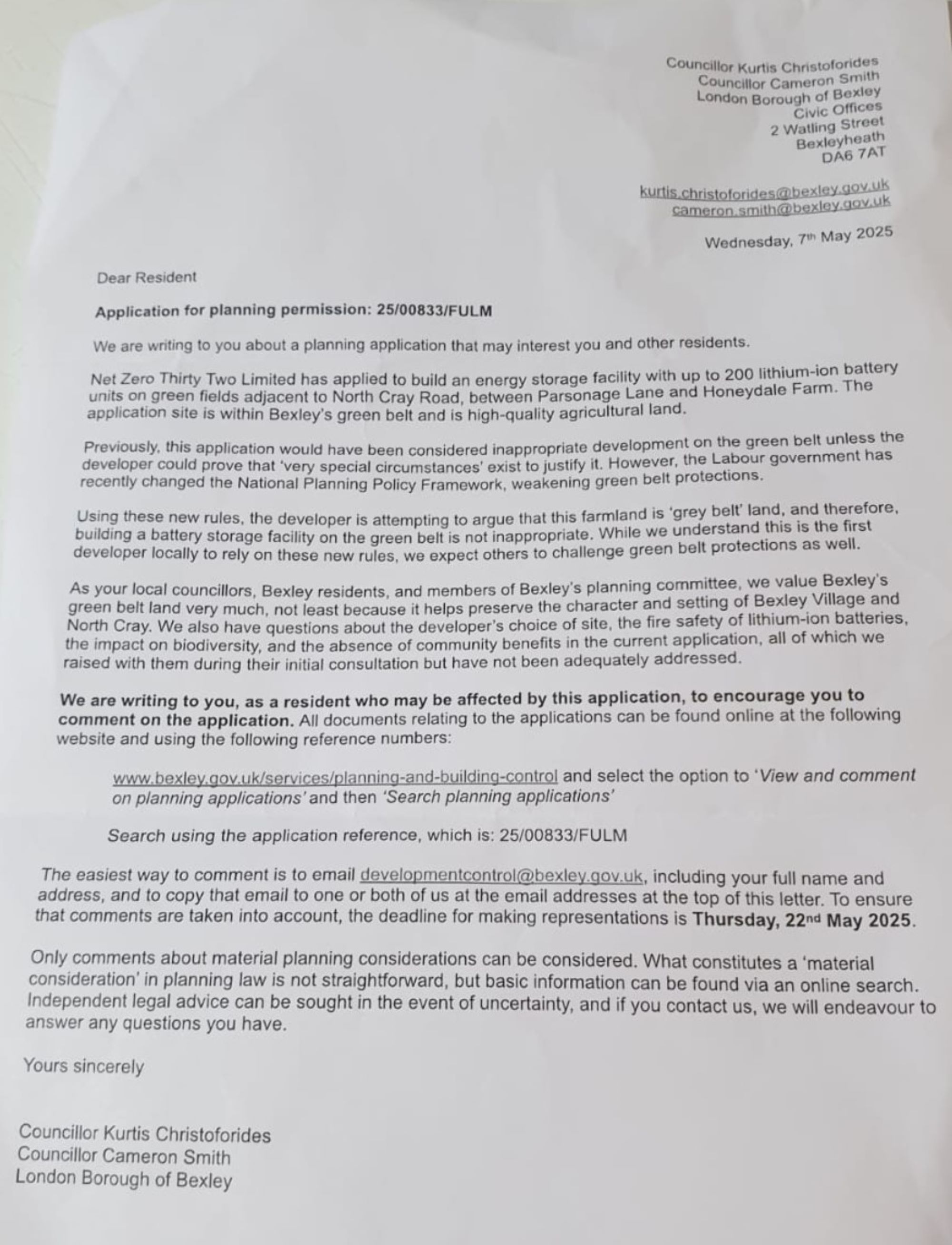
Councillors Kurtis Christoforides and Cameron Smith have
written to nearby residents
urging them to object. The Planning Portal suggests that 69 may already have
done so but the site has not allowed me to read objections. With 53 complex documents submitted by the
developer it is next to impossible to make a sensible objection without days of
study and technical understanding.
The cut off date for comments is next Thursday.
The development would not have been possible without the recent intervention of
Ed Miliband who has changed the rules to suit his Net Zero agenda. Green belt is
downgraded to ‘grey belt’ whatever that means.
The battery will have a capacity of 200 megawatts according to the summary of the
proposal on Bexley Council’s website which anyone who passed their GCE physics exam
will recognise for the technical nonsense that is. What else would you expect from Bexley Council?
Assuming Bexley Council meant to say 200 megawatt hours the facility would
be, if my own consumption is typical, enough to keep 16,000 houses running for 24 hours.
I can only assume that the plan is to charge the batteries overnight when demand
may be low and discharge when demand - and price - is higher. Having installed
my own system a couple of years ago I do find myself wondering how noisy it
will be. The inverters tend to buzz and need cooling.
With so many people encouraged to charge batteries and cars overnight, for how much longer
will the early hours of the morning be a period of low electrical demand?